
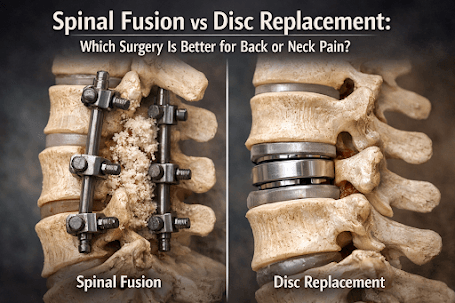
Chronic back or neck pain can limit movement, disturb sleep, and reduce quality of life. When medications, physiotherapy, and lifestyle changes fail, surgical treatment becomes necessary. Two commonly recommended procedures are spinal fusion and disc replacement. Understanding how these surgeries differ helps patients choose the most effective option for long-term relief.
What Is Spinal Fusion Surgery?
Spinal fusion is a surgical technique that permanently joins two or more vertebrae to stabilize the spine. It is often advised for conditions such as degenerative disc disease, spinal deformity, or vertebral fractures.
Benefits of Spinal Fusion
• Eliminates painful spinal motion
• Provides strong stability to the affected segment
• Reduces pressure on compressed nerves
Limitations of Spinal Fusion
• Loss of flexibility at the fused level
• Longer healing and rehabilitation period
• Increased load on nearby spinal segments
What Is Disc Replacement Surgery?
Disc replacement is a motion-preserving procedure where a damaged disc is replaced with an artificial implant. It is mainly recommended for patients with single-level disc problems causing back pain or neck pain.
Advantages of Disc Replacement
• Maintains natural spinal movement
• Faster recovery and return to daily activities
• Lower risk of adjacent segment stress
Possible Limitations
• Not suitable for advanced arthritis
• Limited to select patient profiles
• Requires precise surgical planning
Key Differences Between the Two Procedures
Spinal fusion focuses on stability by stopping movement, while disc replacement aims to preserve motion. Fusion is more suitable for complex or multi-level issues, whereas disc replacement is ideal for isolated disc damage. The choice depends on spinal alignment, age, activity level, and overall spine health.
Which Surgery Is Better for Back or Neck Pain?
There is no single best surgery for everyone. Patients with severe instability or deformity may benefit more from fusion, while those with localized disc problems may achieve better outcomes with artificial disc surgery. A detailed clinical evaluation and imaging studies are essential before deciding.
Recovery and Long-Term Results
Both procedures have high success rates when performed on the right candidates. Post-surgery rehabilitation, posture correction, and lifestyle modifications play a crucial role in maintaining long-term spinal health and preventing future issues.
Consult our Dr. Sreenath Rao Jakinapally, Best Spine Surgeon in Hyderabad, for expert diagnosis and advanced spine treatment.
Conclusion
Spinal fusion and disc replacement are effective surgical options for treating persistent spinal pain. The best choice depends on individual diagnosis, spine condition, and long-term mobility goals.
A personalized approach guided by an experienced spine surgeon ensures better recovery, safety, and lasting pain relief.
Early consultation and timely treatment can prevent progression of spinal disorders and improve quality of life.
Recent Comments