
Cervical disc replacement (CDR) is a modern surgery used to treat neck and arm pain caused by a damaged disc. It involves removing the damaged disc and replacing it with an artificial disc designed to maintain neck motion. Before you decide, let’s clear up the confusion.
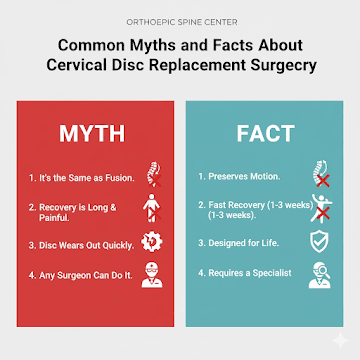
❌ Myth 1: Disc Replacement is the Same as Fusion
- The Myth: If I get disc replacement surgery, my neck will be stiff and I won’t be able to turn my head normally.
- The Fact: False! This is the biggest difference between CDR and its alternative, Anterior Cervical Discectomy and Fusion (ACDF).
- Fusion (ACDF): Locks two vertebrae together using a cage and bone graft. This stops all motion at that segment.
- Replacement (CDR): Uses a device (artificial disc) designed to mimic the natural motion of the original disc, preserving neck flexibility.
🚫 Myth 2: Recovery is Extremely Long and Painful
- The Myth: I’ll be in the hospital for a week and won’t be able to work or drive for months.
- The Fact: False! CDR is considered a minimally invasive procedure with a relatively fast recovery compared to many other surgeries.
- Most patients go home the same day or the morning after surgery.
- Many patients notice immediate relief from arm pain (caused by nerve pressure).
- You are usually encouraged to start gentle movement quickly and can often return to light work in 1–3 weeks.
😬 Myth 3: The Artificial Disc Will Wear Out Quickly
- The Myth: The plastic or metal disc will eventually break down or need to be replaced again in a few years.
- The Fact: False! Artificial discs are designed for long-term durability.
- Modern artificial discs are made from durable materials (like titanium or specialized polymers) that have shown excellent longevity in clinical studies.
- The goal of the surgery is to be a one-time fix for the life of the patient. The success rates for avoiding a second surgery at the same level are very high.
⚕️ Myth 4: Any Surgeon Can Perform This Procedure
- The Myth: Disc replacement is now a standard, simple surgery, so experience doesn’t matter much.
- The Fact: False! While CDR is common, it requires highly specialized training and experience.
- The surgery is performed near the spinal cord, and precise placement of the artificial disc is crucial for long-term success and motion preservation.
- Action for the Reader: Always choose a board-certified, fellowship-trained orthopedic spine surgeon or neurosurgeon with significant experience specifically in cervical disc replacement.
✅ The True Benefit of Cervical Disc Replacement
The biggest and most important fact is that CDR not only relieves the pain caused by the damaged disc but may also help protect the rest of your spine.
By preserving motion at the damaged segment, there is evidence that CDR reduces the stress placed on the discs above and below the surgical site, potentially lowering the risk of needing surgery at adjacent levels in the future.
Recent Comments